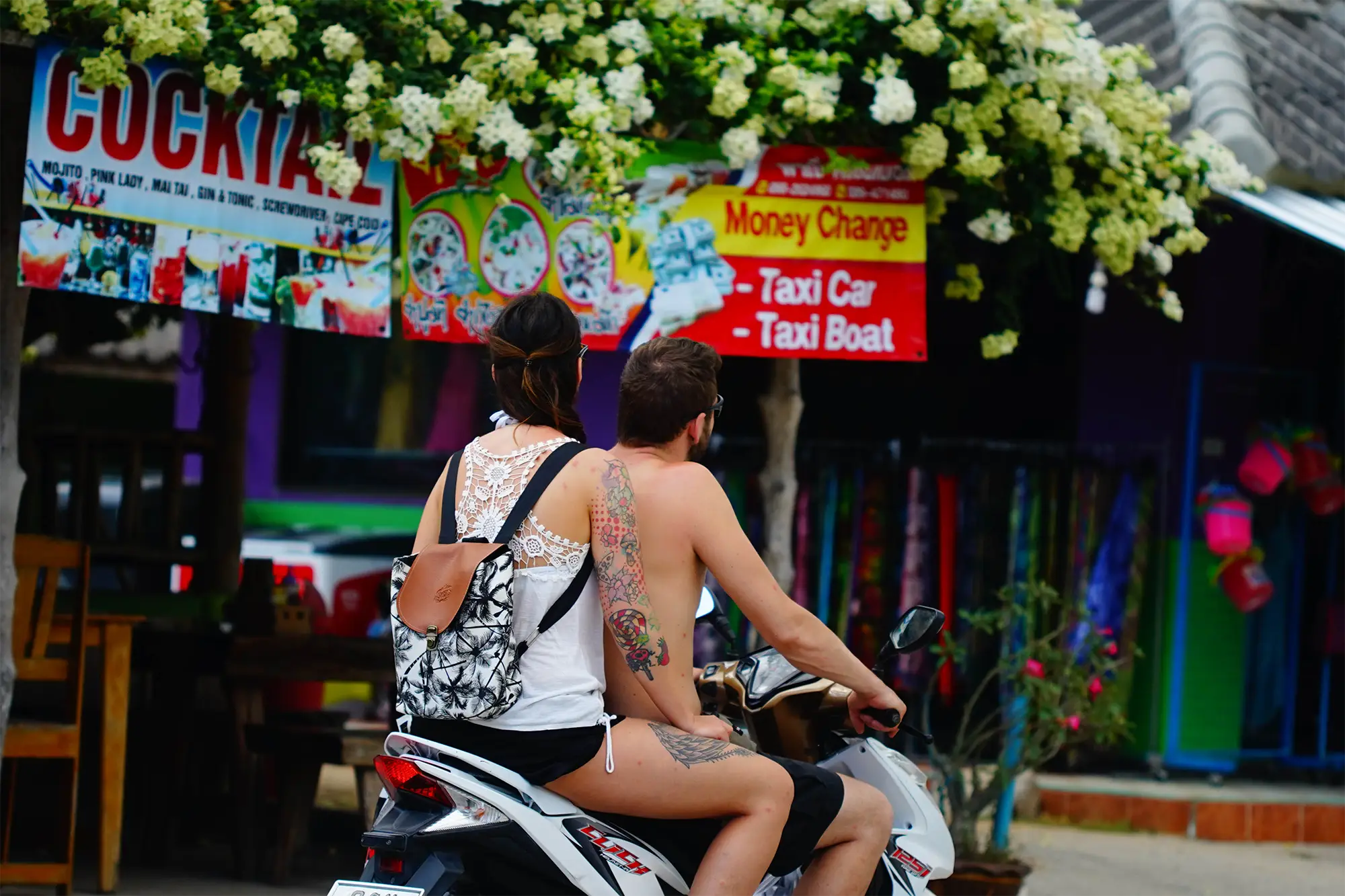
Scooter in Koh Phangan — the complete guide to renting, riding safely, and enjoying the island.
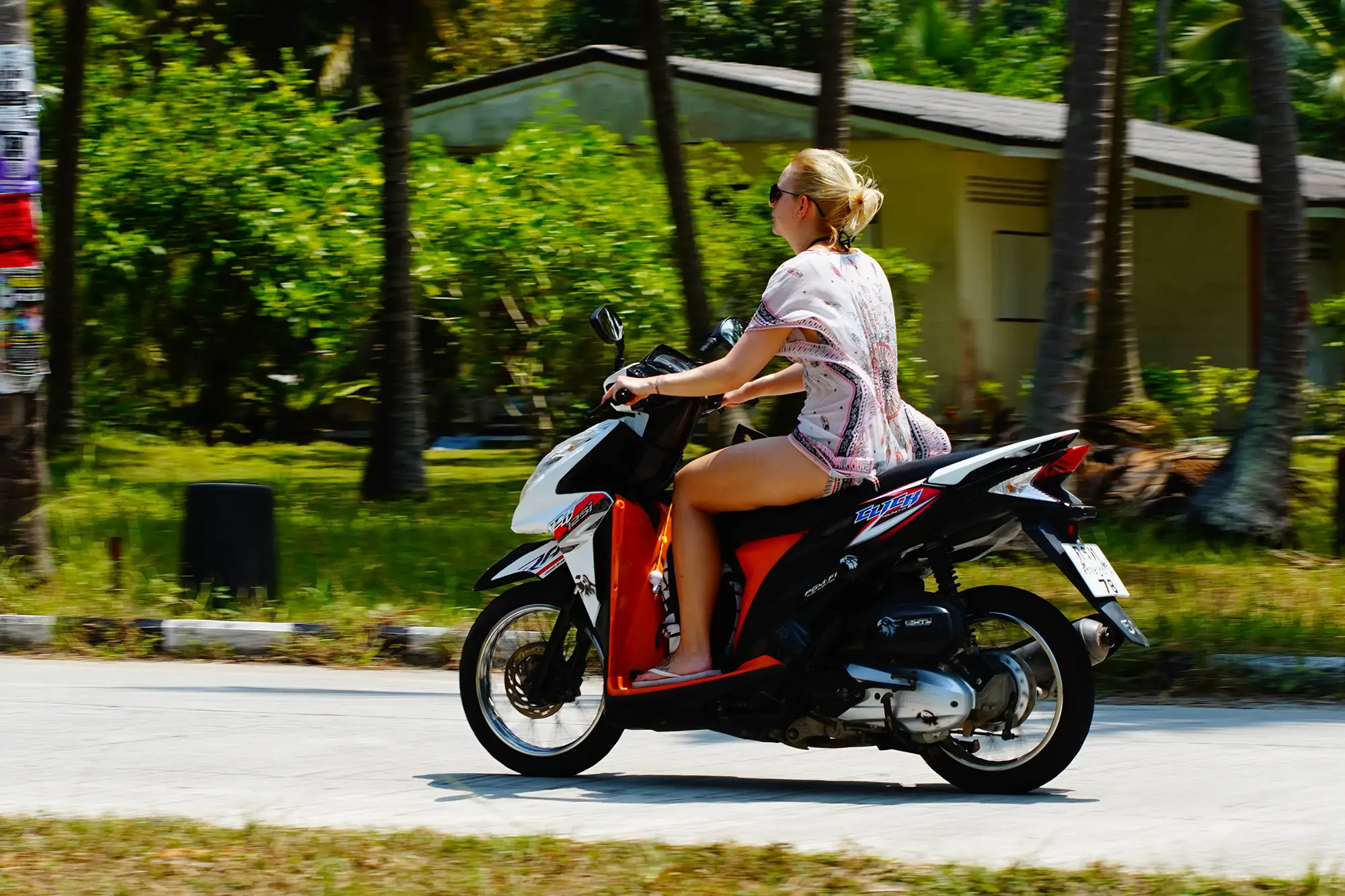
Exploring Koh Phangan by scooter is part of the island’s experience. For a confident rider, it’s often the simplest way to reach a beach, a restaurant or a viewpoint, change plans along the way, and park without any hassle.
But a scooter isn’t automatically the right choice for everyone. Koh Phangan is hilly, driving is on the left, and routes that look easy on a map can end in a steep slope, a narrow lane or a sandy track. The real question isn’t only whether you can rent a scooter — it’s whether you can ride it comfortably in these conditions.
A licence and an international permit remain essential to be in order. They don’t say when you last rode, or whether the basics are still automatic. The reverse is also true: experience never replaces the documents you’re legally required to carry. Legality and real riding ability are two separate conditions.
Most stays go by without incident. This guide isn’t meant to make every ride feel risky — it’s meant to help you choose the right vehicle, understand the island’s quirks, and keep enough margin to actually enjoy it.
A scooter mainly suits riders with real, recent two-wheeler experience.
A Thai 110 or 125cc scooter is legally a motorcycle — you need the right licence category and a valid international permit.
125cc is enough for most stays; a bigger engine never makes up for a lack of experience.
Sand, slopes and final approaches are the main local traps.
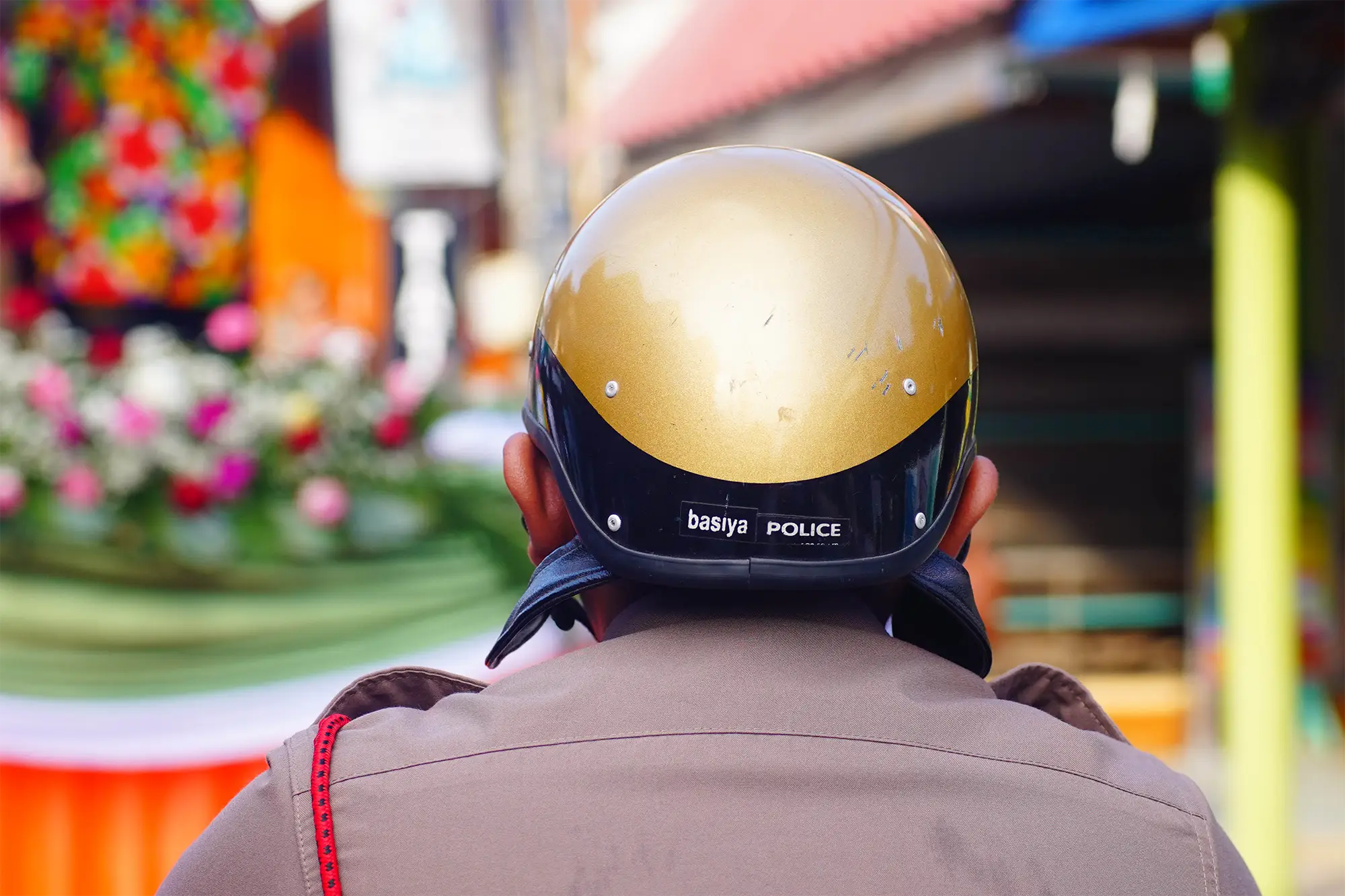
Always wear a properly fitted, fastened helmet — rider and passenger.
When in doubt: slow down, park lower down, or turn back.
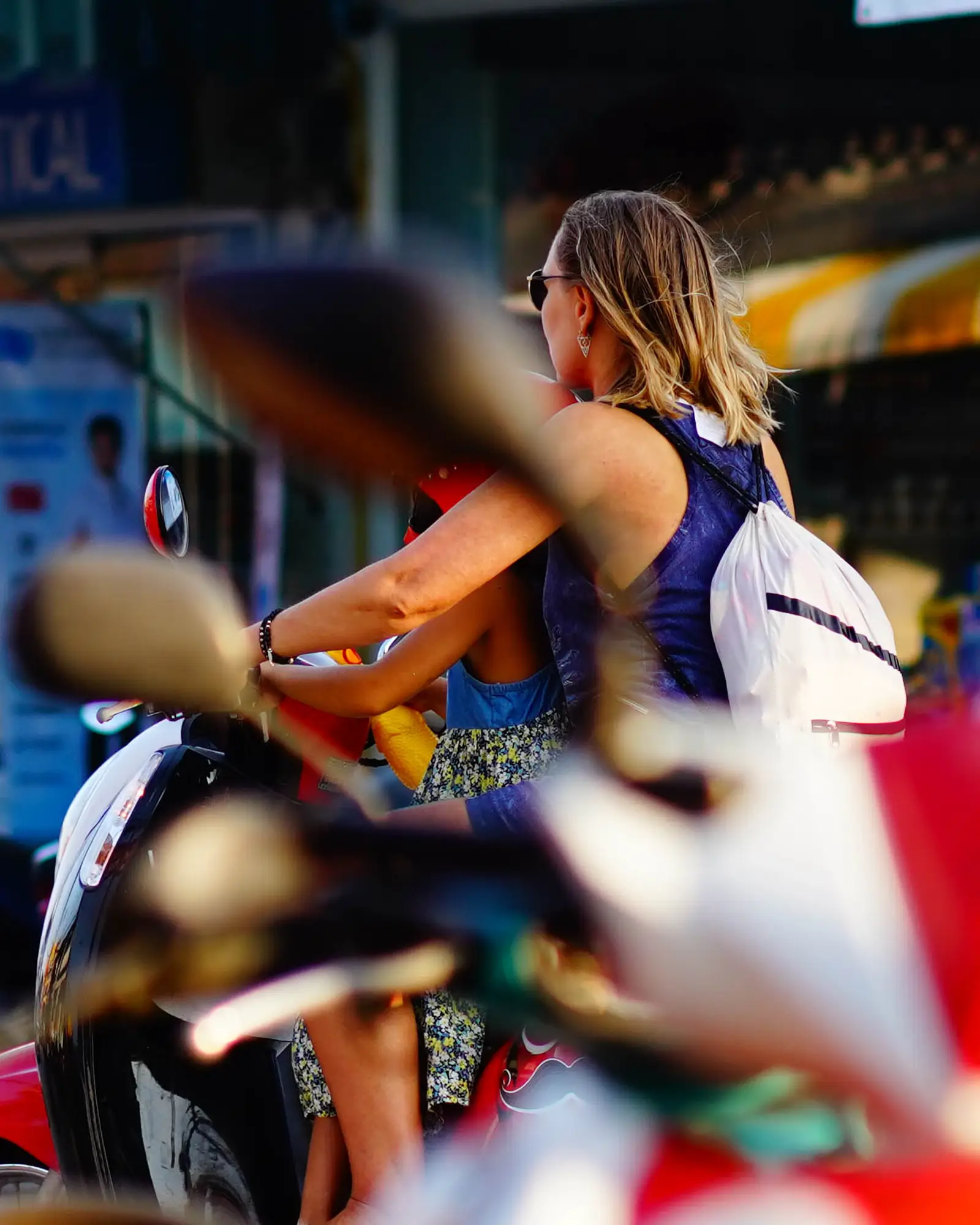
1. Is a scooter really right for you?
In Koh Phangan, renting a scooter is generally easy. Knowing whether you should actually ride one takes a bit more honesty.
Recent experience matters as much as your licence
A motorcycle licence proves you were granted the right to ride a category of two-wheeler. It doesn’t show whether you ride regularly, whether your last real experience was twenty years ago, or whether you’re still comfortable at very low speed.
A rider who practices regularly has useful reflexes: starting off without rushing, modulating the brakes, keeping balance on a slope, anticipating a car that’s slowing down, looking far ahead. Someone still getting used to the throttle, balance or braking needs to devote far more attention to every single movement.
This difference matters in Koh Phangan, because how hard a route is doesn’t only depend on distance. A simple road can quickly turn into a steep slope, a blind bend or a tricky private access. For an experienced rider, these shifts are usually manageable. For a complete beginner, they can become stressful.
Koh Phangan is genuinely enjoyable to explore by scooter once the basics are already there. It isn’t the best place to learn from zero.
Be honest about your level
You don’t need to be a pro rider. You mainly need to be able to answer yes to most of these questions:
Have you ridden a scooter or motorcycle recently?
Are you comfortable starting, stopping and manoeuvring slowly?
Can you pull away on a slope and control your speed going downhill?
Can you react calmly when a vehicle slows down or edges into your lane?
Are you willing to ride slowly even if others overtake you?
Can you stop or turn back when a road doesn’t feel right?
Driving on the left also comes into play. Experienced riders usually adapt fairly fast, but old habits can resurface leaving a car park, at a junction, or on an empty road. If you’re still consciously thinking about balance, braking and the throttle, that adjustment demands a lot more attention.
Fear is another useful signal. A very tense rider often looks too close in front, hesitates in manoeuvres, and brakes more abruptly. Not feeling at ease doesn’t mean lacking courage — it simply means a car may suit this trip better.
Riding two-up changes everything
A passenger’s weight changes how the scooter starts, brakes, balances and manoeuvres at low speed. The difference is most noticeable on slopes and during U-turns.
The rider should try the scooter alone before taking a passenger. The passenger should stay centred, avoid sudden movements, and keep their feet on the footrests. A short first ride on an easy road confirms the rider keeps the same ease two-up.
For a family with young children, a car is generally more coherent — easier for transport, better protection from the weather, and it doesn’t put the constraints of a two-wheeler on the whole family.
Don’t start your stay with the most demanding accesses. The main roads around Thong Sala and Baan Tai are better suited to finding your bearings. The road to Haad Rin needs more confidence, and the final approach to Bluerama should be avoided unless you’re entirely comfortable on a steep slope.
When a car is the better call
Choose a car if you’ve never ridden a motorised two-wheeler, if your experience is very old, if you already feel tense before setting off, or if you’re travelling with young children and plenty of luggage.
A car is also the right choice when you know you’d tend to follow a group despite feeling uncomfortable. On the island, more experienced friends may ride at their own pace or choose a road they know. You’re never obliged to follow them.
A licence is mandatory, but it doesn’t guarantee recent practice. For your safety, real experience, composure and the willingness to say no matter just as much. If the basics aren’t automatic, choose a car.
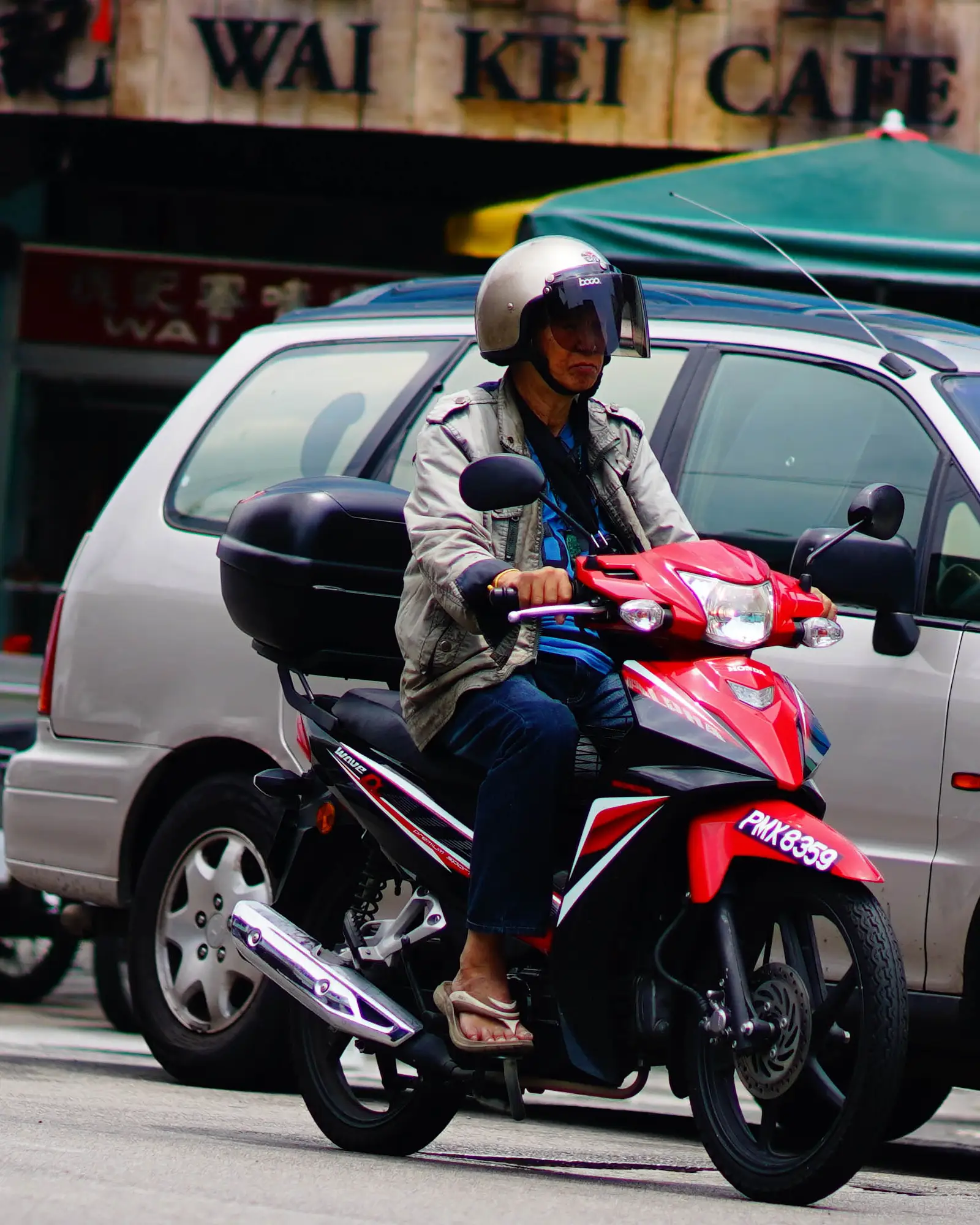
2. Scooter or car: which should you choose in Koh Phangan?
A scooter is often more practical. A car is more comfortable and more protective. The right choice depends on your experience, your group, the weather and how busy the island is.
What a scooter gets you
A scooter lets you leave whenever you like, stop easily, and change your route without a long search for parking. It’s generally cheaper to rent, sips fuel, and suits Koh Phangan’s distances well.
Its advantage is especially visible in high season or around an event. In busy areas, it moves and parks far more easily than a car.
The trade-off is obvious: rider and passenger are exposed to the weather with far less physical protection. A scooter is also impractical with several suitcases, young children, or a passenger when the rider lacks experience.
What a car gets you
A car protects better from rain, offers air-conditioning, and makes it easy to carry groceries, beach gear or luggage. It particularly suits families, less experienced riders, and travellers who prefer comfort to the flexibility of parking anywhere.
It has its own limits, though. Some accesses are narrow, manoeuvres get tricky when traffic is heavy, and parking can be difficult near beaches, markets and events.
Outside the busiest periods, a car becomes far simpler to use again — and during a very rainy spell, it can make getting around noticeably more pleasant.
During the big nights at Zen Beach, especially around Happy People events, the road and parking areas can get heavily saturated. This is occasional — by car, it’s best to arrive early, park further away, or take a taxi.
The most logical choice by profile
No single option is perfect for every situation. You can also combine the two: rent a scooter for everyday trips, and take a taxi when the weather, the hour or the evening make riding less sensible.
3. Licence, regulations and helmets
How easily a scooter can be rented in Koh Phangan often creates a misunderstanding: the rental shop supplies the vehicle, but it doesn’t decide whether you’re legally allowed to ride it.
A Thai scooter is a motorcycle
Common 110, 125, 150 or 160cc models are legally motorcycles, even though they’re automatic and easy to use. A car licence alone doesn’t automatically grant the right to ride them in Thailand.
To be in order, a traveller should normally hold: a valid national licence, a motorcycle category matching the vehicle, and an international permit recognised in Thailand.
The international permit is an official translation of the national licence. It doesn’t create any additional right. If your national licence doesn’t carry a recognised motorcycle category, the international permit can’t add one.
Some national authorisations aren’t necessarily valid abroad. For French travellers, the seven-hour training linked to a car licence shouldn’t automatically be treated as valid in Thailand. For German travellers, the B196 extension is a national authorisation that doesn’t necessarily equate to an A1 category recognised abroad.
Some older licences may grant particular rights depending on the country and the date they were issued. Check the categories actually listed on your national licence and your international permit with the authority that issued them.
During your stay, keep your national licence, international permit and a form of ID or an accessible copy of your passport together.
A 110 or 125cc scooter is a motorcycle. To ride it legally, you need a matching motorcycle category on your national licence, plus an international permit valid in Thailand. The fact that a rental shop hands over the keys doesn’t prove the rider is in order.
What actually happens on the island
Many rental shops only check a passport or an ID. This commercial flexibility is why some visitors assume they’re allowed to ride simply because they managed to rent the vehicle.
That reasoning is wrong. Renting a scooter prevents neither a fine nor consequences for insurance or liability after an accident. The rental shop doesn’t assess your actual ability to handle the scooter either.
For a long stay or a move to Thailand, the international permit shouldn’t be treated as a permanent solution. The Thai driving licence is covered later in this guide.
Helmets: mandatory for rider and passenger
In Thailand, a helmet is mandatory for everyone on a scooter, whatever the distance. The law provides for a fine of up to 2,000 THB for riding without one, though the amount applied can vary by checkpoint and circumstances.
In practice, helmet use remains inconsistent in Koh Phangan. Seeing locals or tourists ride without one doesn’t make it legal, and it doesn’t reduce the consequences of a fall.
Checkpoints are regularly set up around Thong Sala and the main roads. Their location and timing can change — the goal shouldn’t be to avoid them, but to stay compliant everywhere.
A helmet needs to fit, and be fastened
A helmet that’s too big can shift, ride up over the forehead, or come off in an impact. When choosing one, check that it stays in place when you shake your head lightly, that it covers the forehead properly, and that the chin strap works.
Your passenger needs a helmet just as good as the rider’s. If the one offered is cracked, too loose, or impossible to fasten, ask for another.
Wear the helmet even for a few minutes’ ride. A fall can happen leaving a car park, near the villa, or during a slow manoeuvre. Always fasten the chin strap.
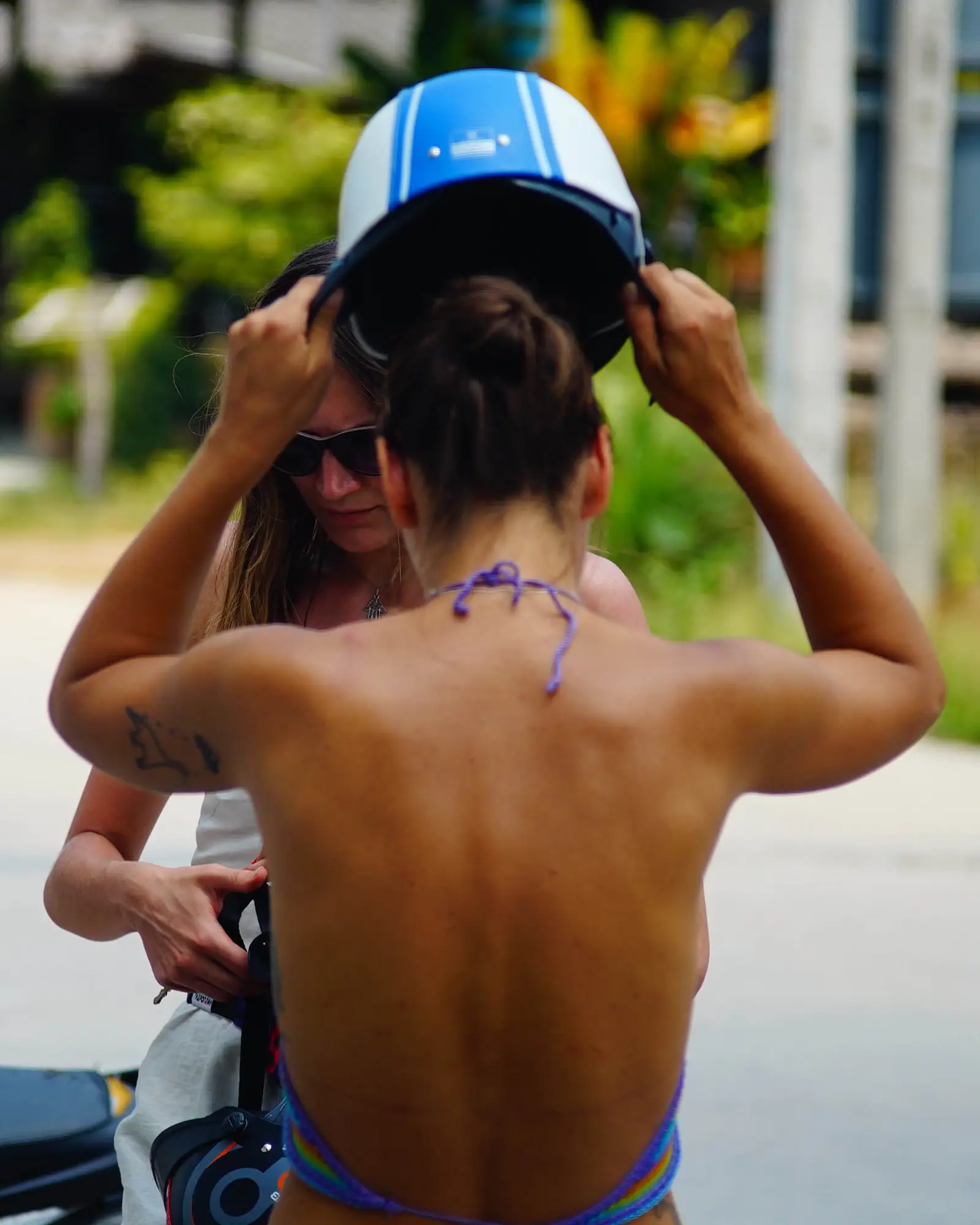
4. Renting and checking your scooter
Once the decision is made, don’t choose purely on the lowest price. A few dozen baht of difference matters less than the quality of your relationship with the rental shop when a flat tyre, a breakdown, a lost key or a scratch discussion comes up.
How to recognise a serious rental shop
Most rental shops are around Thong Sala, along the road to Baan Tai, and in the main tourist areas. Renting right off the ferry can be convenient, but it isn’t always the best moment to compare conditions — with the heat, the luggage and the urge to arrive, it’s easy to accept the first available vehicle.
That doesn’t mean shops at the port are suspect. The main risk comes from rushing.
A serious rental shop should be able to clearly explain: the rate, the duration and the return time; the expected fuel level; the procedure in case of breakdown or flat tyre; the cost of a lost key; how damage is assessed; and who to contact outside opening hours.
They should also let you inspect the scooter, photograph any existing flaws, test the brakes, and ask for another helmet if the one offered doesn’t fit.
Online reviews can help, but the most useful ones explain how a problem was handled — not just that the scooter was clean on day one.
A standard automatic scooter typically costs a few hundred baht per day. It varies with the model, duration, season and sometimes Full Moon timing. A longer rental is often cheaper per day, but price should never replace the basic checks.
A label like “scooter insured” isn’t enough to understand the coverage. Simply ask whether a voluntary insurance exists and what it covers — the different insurance types are explained later in this guide.
Passport as a deposit: common, but not ideal
Several consular authorities recommend keeping your passport and offering a financial deposit or another form of guarantee instead. In case of a dispute, a traveller shouldn’t end up without their travel document.
Handing over the original passport remains very common, especially around Thong Sala. In most rentals it’s returned normally. This habit isn’t necessarily a sign of bad intent, but it puts the traveller in an uncomfortable position if a dispute arises.
Keeping your passport remains the safest option. When a reasonable financial deposit is accepted, it deserves to be preferred. This isn’t available everywhere, though, and the amount can reach several thousand baht, or more for a newer or more powerful model.
If you do agree to leave your passport: choose a shop with an established reputation, get the deposit written into the contract or ask for a receipt, keep a digital copy of the document, note the shop’s name, number and address, check when the passport can be retrieved, and ask where it will be kept.
Don’t assume it can be retrieved mid-rental without returning the scooter. This can become awkward if you need to leave the island early or present the document elsewhere.
See how to prepare the return and get your passport back →
125cc or 160cc?
For most stays, a 110 or 125cc automatic scooter is enough. These models are lighter, easier to manoeuvre, and well suited to trips between beaches, restaurants and villages.
A 150 or 160cc offers more pickup on slopes and sometimes a more comfortable seat two-up. It’s also heavier, more cumbersome in manoeuvres, and harder to hold back on a slope. Its price, deposit and some parts can cost more.
A more powerful scooter climbs a hill more easily. It doesn’t make its rider more experienced.
Before accepting a model, check that you can put your feet down properly, straighten it up, reverse it, and do a slow U-turn without excessive effort. Some personal insurance policies also limit coverage to 125cc or less — this depends on the contract.
See the difference between Por Ror Bor, scooter insurance and travel insurance →
Don’t choose a heavier model purely because it looks more comfortable or more impressive. In Koh Phangan, ease of handling usually matters more than power.
The rental shop we recommend to Altura Villa guests
For Villa Altura guests, we can recommend a small rental shop in Thong Sala that we know personally. We don’t present it as the only good rental shop on the island, or the cheapest. We recommend it because we know who we’re sending our guests to, and we can contact them directly if a question comes up.
We prefer to be transparent: they also ask for a passport as a deposit, like many small rental shops in the area. We keep recommending them because the relationship is established, and if a problem arises, our guests aren’t left alone facing a stranger.
As their rates, availability and conditions can change, practical details are shared directly during your stay.
Before you set off: the checks worth doing
A few minutes are enough to spot an obvious flaw, keep proof of the scooter’s initial condition, and check that the essential controls work.
1. Film the scooter. Slowly walk around both sides, showing the panels, mirrors, rims, exhaust and any existing flaws.
2. Look at the tyres. They shouldn’t look significantly deflated, nearly bald, cracked, or unevenly worn.
3. Test the brakes. Try each one separately at very low speed, in an open space.
4. Check the equipment. Lights, indicators, horn and mirrors should work and stay in place.
5. Try the helmets. Size, chin strap and apparent condition matter for both rider and passenger.
6. Save the rental shop’s contact. Confirm the fuel level, the expected level on return, and the return time.
With a smart key, ask how to lock the scooter and avoid leaving the fob in the storage box. Keep the photos and video until you’ve returned the scooter and got your passport or deposit back.
Take a few minutes to get to know this scooter
Even if you ride regularly, throttle sensitivity, braking, weight and turning radius can differ from what you’re used to.
Ride a few metres slowly, test the brakes, and turn at low speed before joining traffic. If you’re travelling two-up, try the scooter alone first.
A clear one-minute video and a few simple tests are more useful than a long improvised inspection. If a tyre, a brake or a helmet feels off, ask for another scooter before you leave.
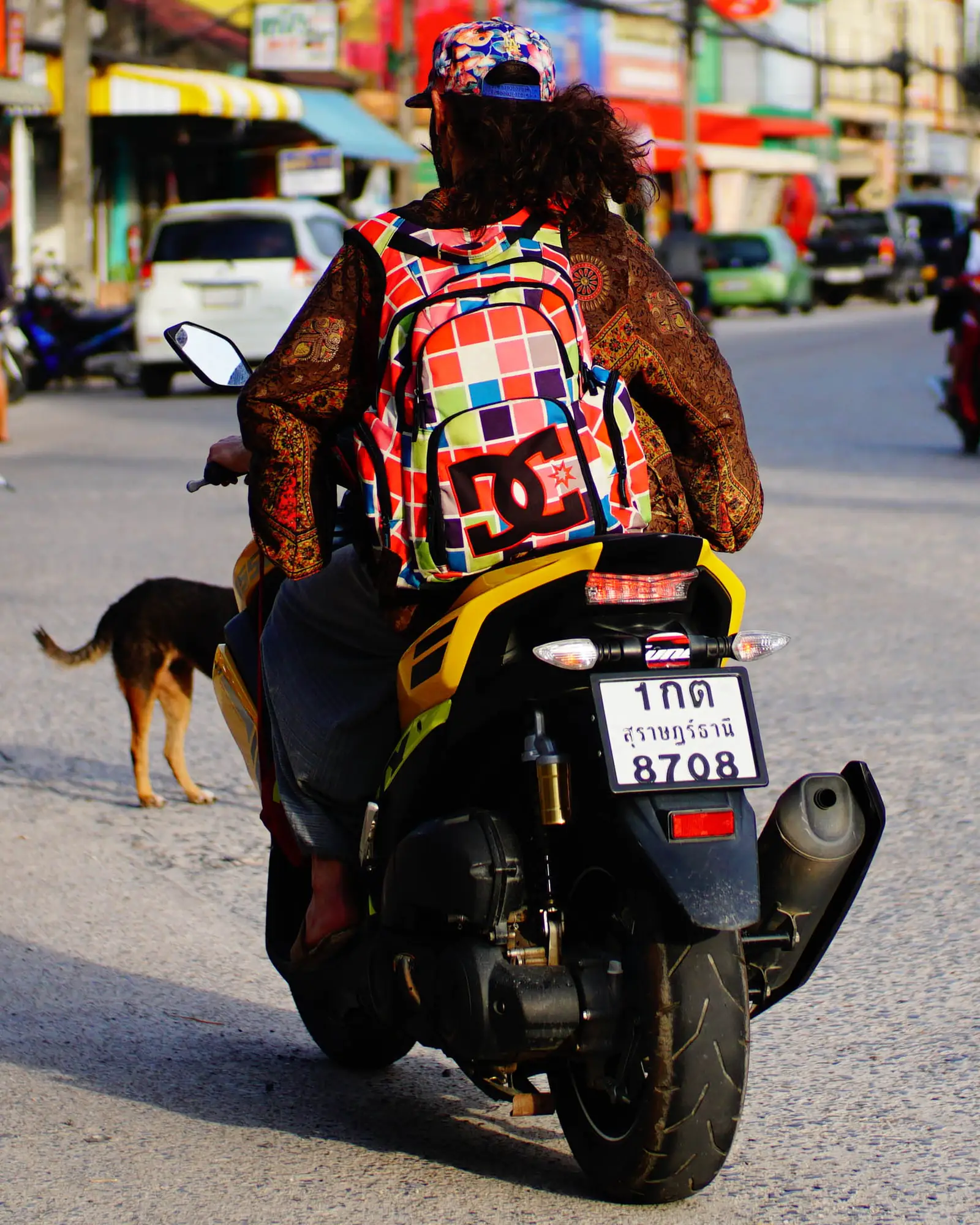
5. The roads of Koh Phangan: what you really need to know
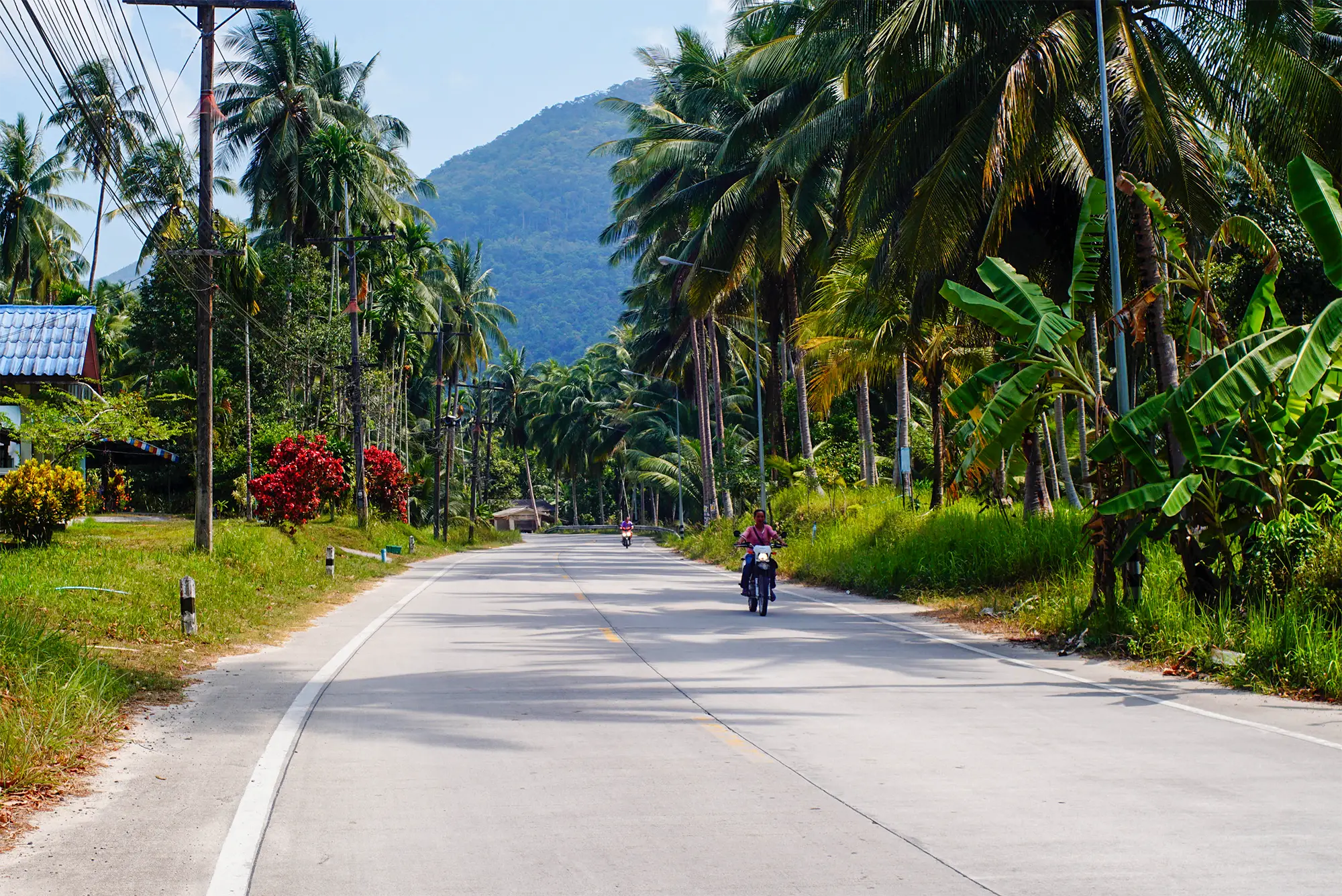
Distances are reasonable and many roads are in good condition. The real difficulty comes from sudden changes: a wide road can turn into a narrow concrete lane, then end in a slope, sand, or a private access with no room to turn around.
An app can tell you a destination is a few kilometres away. It doesn’t always tell you what’s waiting in the final fifty metres.
Main roads and final approaches
The main roads around Thong Sala and Baan Tai are generally the easiest for finding your bearings. Parts of the west coast, towards Sri Thanu, also stay accessible in normal conditions.
These roads aren’t free of sand, traffic or surprises, but they suit a first outing better than the hilly, secondary tracks. The main road to a beach, villa or restaurant can be perfectly simple while the final approach is steep, narrow or slippery. Before committing, look at where you’ll be able to stop, pass another vehicle, and turn around.
Slopes: think about the way down too
Climbs get the attention, but descents often demand more control. Going up, the difficulty appears when you have to stop behind a car, restart mid-slope, or pass a wide vehicle. Going down, the scooter picks up speed quickly and your braking margin shrinks.
A dry, clear slope can be simple alone. It becomes more demanding with a passenger, in the rain, or when a vehicle comes the other way. U-turns are also far harder on an inclined road.
The best moment to turn back is before the slope. Stop somewhere stable, look at what’s ahead, and walk a few metres if needed. Before riding down to a place, always ask whether you’ll be able to ride back up the same way — possibly two-up, and after a downpour.
Keep your distance from the vehicle ahead too. A car can slow down or stop mid-climb. Don’t automatically follow another scooter — its rider may be travelling alone, know the road, or simply have more experience.
If an access makes you hesitate, park lower down, finish on foot, or take a taxi. Turning back before a difficult slope is a good decision, not a failure.
Sand and loose gravel: the most common trap
Sand isn’t only found near beaches. It can appear at the end of a track, in front of a building site, after a pick-up has passed, at the edge of a bend, or at the bottom of a slope after rain. On light-coloured tarmac, it can be hard to see.
The risk is loss of grip: when a scooter brakes, leans or changes direction suddenly on sand, the tyres can let go very fast.
The right reflex is simple: spot the patch as early as possible, slow down before reaching it, straighten the scooter up as much as you can, keep a steady line, and avoid braking, accelerating or changing direction sharply once on it.
In a bend, sand is trickier because the scooter is already leaning. Match your speed to what you can actually see beyond the curve, and keep a margin even when the road looks clean.
Don’t wait until you’re on the sand to brake hard. The decision that matters happens before: see it, slow down, straighten up, and cross without any sudden movement.
Rain, and just after the rain
A tropical downpour can cut visibility within moments. The first few minutes are often the most slippery, as water mixes with dust and residue on the road surface. Painted markings, smooth concrete and quiet areas need particular care.
Rain also shifts sand, dirt, leaves and small gravel. Runoff can leave a slick layer at the bottom of a slope or in a bend.
When a heavy shower starts, stopping for a few minutes at a shop, a petrol station or somewhere visible is often the simplest solution. Don’t stop right at the edge of the road, or under a tree that looks unstable.
After the rain, watch for puddles that may hide a pothole, shifted sand, mud at the end of tracks, wet leaves, and shaded descents. A road that’s dry in the sun can stay wet a few hundred metres further on.
Blind bends, pick-ups and dogs
In a narrow bend, you might meet a taxi, a pick-up, a stopped vehicle, a scooter cutting its line, or a dog in the middle of the road. Stay on a line that leaves you a margin, and ride at a speed matched to what you can actually see. Never assume the opposite side is necessarily clear.
Pick-ups, taxis and songthaews are sometimes wider than the space available. They may stop to pick up a passenger, do a U-turn, or overtake with little margin. Avoid staying in their blind spot and don’t ride alongside them for long.
When you see a dog, slow down early and keep a steady line. Leave space, avoid sudden gestures, and don’t try to push it away with your foot. Most stay put or move off quickly — the key is not to arrive too fast.
Riding two-up and in a group
Two-up, a scooter accelerates less quickly, needs more distance to slow down, and becomes harder to manoeuvre. The passenger gets on once the rider is ready, keeps their feet on the footrests, and avoids sudden movements.
In a group, agree on a meeting point rather than trying to stay glued together. Don’t ride side by side, and never go beyond your level just to keep up with the person ahead.
Night, Full Moon and busy periods
At night, sand, road defects and animals are harder to spot. Some areas are poorly lit, and oncoming headlights briefly reduce visibility.
Check your headlight, avoid overly tinted glasses or visors, and slow down. Don’t discover a steep road or a private access for the first time at night.
During big nights out, more scooters, taxis and pedestrians move around at once. Even sober, you need to anticipate the reactions of people who may not be. If you’re planning to drink, arrange the way back before you leave — the scooter can stay parked safely until the morning.
In high season, some areas become temporarily saturated — Zen Beach during big Happy People nights is one example. Outside events and off-season, traffic and parking are generally far simpler.
GPS, tracks and unpaved paths
Navigation apps often favour the shortest route. The shortcut suggested can be a private lane, a dirt track, a very steep path, or a sandy stretch.
Don’t blindly follow an app when it asks you to leave the main road for a narrow or degraded access. Stop, look, walk a few metres, or ask at your destination.
An app knows the distance. It doesn’t know the surface condition that day, recent rain, or your comfort level.
Some accesses to isolated beaches involve deep sand, mud or ruts. A local riding it on their own scooter doesn’t mean your rental and your level are suited to it — the contract may also forbid unpaved tracks. When a track looks too difficult, choose walking, a boat, or a taxi. To check your phone, stop completely, off the road.
Haad Rin and Bluerama: two useful examples
The road to Haad Rin has climbs, long descents and several bends. It also carries more taxis and traffic at certain times. It isn’t a problem for an experienced rider, but it needs more confidence than the main roads around Thong Sala and Baan Tai.
It isn’t the best first ride for someone who lacks confidence — better to discover it by day and in good conditions than for the first time during a Full Moon Party night.
Bluerama presents a different challenge: the final approach is particularly steep. Once committed, you need to climb, manoeuvre, possibly pass another vehicle, then ride back down. If you’re not entirely comfortable on a steep slope, park lower down or take a taxi.
The same logic applies to many villas, restaurants and viewpoints up in the hills. Never confuse the general road to a place with the final metres to reach it.
Read the essential riding principles →
6. Essential riding advice
Once you understand the island’s quirks, a few principles go a long way toward reducing uncomfortable situations.
Ride at your own pace
There’s nothing to gain from riding fast in Koh Phangan. Distances are short, and a few extra minutes rarely change a day. A reasonable pace leaves more time to spot a dog, a stopped vehicle, a driveway, or a patch of sand.
Staying around 40km/h is an Altura Villa rule of thumb for many touristic trips, not a confirmed island-wide limit. In a village, on a descent, in a blind bend or after rain, you often need to ride much slower. The right speed is the one that lets you stop within the stretch of road you can actually see.
Keep your distance
Don’t ride too close to a scooter, taxi or songthaew ahead of you. The vehicle in front can brake, hesitate, look for its way, or stop to pick up a passenger. Extra margin is especially useful approaching a bend, at night, after rain, and in busy areas.
Don’t let the group decide for you
The person ahead may know the road, be travelling alone, or simply be taking more risks. Agree on a meeting point and let everyone ride at their own pace.
If a road feels above your level, stop somewhere safe. Parking lower down, finishing on foot, or calling a taxi is always better than pushing on under pressure.
Fatigue, alcohol and cannabis
Fatigue reduces attention and stability, especially at the end of a long day. Alcohol, cannabis and anything else affecting alertness or balance make riding incompatible with a reasonable safety margin.
Arrange the way back before a night out. Arriving by scooter doesn’t oblige you to leave on it — park it properly and pick it up when you’re rested and fully fit to ride.
Ride calmly, keep your distance, never follow a rider above your level, and change your plan the moment the weather, your fatigue or the road no longer suit you.
7. Falls, accidents and care
A fall doesn’t always mean a serious accident. Reacting correctly starts with telling three situations apart.
A small fall, no one else involved
You slipped or laid the scooter down without touching another person, vehicle or property. There may be a few scrapes and minor damage to the scooter.
In this case: move away from traffic; switch off the engine and check on yourself and your passenger; don’t lift the scooter back up if significant pain stops you; photograph the vehicle and the spot; notify the rental shop; get any wound properly cleaned and keep the receipts.
Don’t have the scooter repaired at a random shop without the rental company’s agreement — the vehicle belongs to them, and an unauthorised repair can complicate things.
An accident involving someone else
Another scooter, a car, a pedestrian, or someone else’s property is involved. Questions of liability, insurance and police become more important.
First check whether anyone is hurt. When it can be done safely, photograph the position of the vehicles before moving them, then note the number plates, the damage, the state of the road, the time and location, and the contact details of those involved and any witnesses.
Contact the rental shop quickly — they know the scooter, its insurance and local procedures. The police or Tourist Police become particularly useful when someone is injured, a third party is involved, there’s a disagreement, or a report is needed for insurance.
A medical emergency
Someone is unconscious, disoriented, bleeding heavily, in intense pain, possibly has a fracture, or shows worrying symptoms after a head impact.
Here, health comes before the scooter and the paperwork. Call the emergency services and follow their instructions. Avoid moving someone with a possible head, neck or back injury unless they’re in immediate danger.
1669 — medical emergency and ambulance
191 — police
1155 — Tourist Police
The Tourist Police can help when a language barrier complicates the situation, or when a traveller needs assistance in English.
A small fall with no one else involved is usually handled with any needed care plus the rental shop. As soon as another person is involved, document the situation and consider calling the police — especially to establish liability or get an insurance report.
Who to notify, and in what order
The priority is simple: emergency services if someone is hurt; the rental shop once the immediate emergency is under control; the police or Tourist Police when a third party, a disagreement or a significant injury is involved; and your travel insurance’s assistance line if significant care is needed.
Avoid signing a document only written in Thai, admitting a liability you don’t understand, or paying a large sum under pressure. Ask the rental shop, your insurer or the Tourist Police for help before agreeing to anything significant.
Getting treated in Koh Phangan
The island has a public hospital and several private facilities able to treat common injuries and emergencies, including Koh Phangan Hospital, Phangan International Hospital in Baan Tai, and Thai International Hospital Koh Phangan (sometimes still known by its former name, First Western Hospital).
Names, contact details and services can change — check current information when you need it. In an emergency, call 1669.
When it isn’t an immediate emergency, our team can help you find a suitable facility and ease the first steps. In a medical emergency, call 1669 directly.
A road-related graze needs to be cleaned properly, as sand or small gravel can stay in the wound. After a head impact, seek medical advice quickly if there’s confusion, vomiting, balance problems, blurred vision, unusual drowsiness or a severe headache.
Some injuries, exams or specialist procedures may require a transfer to Koh Samui. That decision belongs to the medical staff, and depends on the patient’s condition, urgency, transport and coordination with insurance.
Being treated, being billed, and being reimbursed
These are three different things. A facility can examine you, treat you and issue a bill. You may need to pay upfront, then get a partial, full, or no reimbursement depending on your insurance and its terms.
Not having the right licence or a helmet generally doesn’t mean an injured person will be refused care. It can, however, lead to penalties, complicate liability, and trigger a refusal by insurance.
Private facilities can offer fast care and easier communication in English, but their rates are sometimes noticeably higher. When it isn’t urgent, ask for an estimate, check whether the facility can contact your insurer, and keep a detailed invoice. Never delay urgent care just to compare prices.
8. Insurance and returning the scooter
The phrase “the scooter is insured” doesn’t tell you what will actually be covered. Three different protections can come into play.
Por Ror Bor
Por Ror Bor is the mandatory bodily-injury insurance attached to the vehicle. It provides basic coverage for certain bodily injuries linked to a road accident.
It shouldn’t be confused with comprehensive cover. It generally doesn’t cover scratches on the scooter, a broken phone, luggage, the full cost of damage to another vehicle, or all the costs of a major hospitalisation.
Voluntary scooter insurance
The owner may have taken out additional insurance covering, depending on the contract, liability toward third parties, certain material damage, theft, or the scooter itself.
It isn’t automatic on every rental vehicle. It can include an excess, caps, exclusions and a requirement to report quickly — which is why the rental shop needs to be told without delay after an incident.
Your travel or health insurance
Travel insurance can cover care, hospitalisation, assistance, transfer or repatriation. It generally isn’t car insurance for material damage caused to the scooter or a third party.
Common exclusions involve not holding the right licence, not having the international permit when required, riding without a helmet, alcohol, drugs, illegal riding, or an engine size above the contract’s limit.
Every policy is different. Check your terms for scooters, motorcycles and engine sizes before your trip. Some insurance policies cap coverage at 125cc, even if the rider holds the licence needed for a 160cc.
Por Ror Bor, scooter insurance and travel insurance don’t cover the same risks. No single one of these replaces the other two.
Documents worth keeping
After an accident, photograph or keep: the rental contract; the Por Ror Bor if available; the rental shop’s contact details; your licences and passport; photos of the accident; the plates and contact details of anyone involved; invoices, certificates and medical results; the police report if there is one; and receipts related to repairs.
Send a digital copy to your email or cloud storage immediately.
Returning the scooter without stress
Tell the rental shop your return time and leave a margin before your ferry or transfer. Check the fuel level, take your belongings out of the storage box, gather the keys, and take a few general photos of the scooter.
If the vehicle was damaged, tell the rental shop honestly. A scratch or a broken part has a real cost, so not every claim is unreasonable. Don’t try to hide damage or have the scooter repaired without authorisation.
If a payment is requested: look at the damage; compare it with the photos taken at pickup; ask for the part’s name and an explanation of the amount; request a receipt; and contact Altura Villa or the Tourist Police at 1155 if no reasonable discussion is possible.
When your passport was left as a deposit, getting it back is a real step of your departure. Don’t return the scooter ten minutes before the ferry — make sure the rental shop will be present, that the inspection can happen, and check immediately that the document handed back is actually yours.
9. Long stays and the Thai driving licence
For a week’s holiday, renting remains generally the simplest solution. When you live on the island for several months, questions of licensing, ownership and insurance become more important.
When to consider a Thai licence
The international permit is designed mainly for temporary visitors. The rule often summed up as “after three months you need a Thai licence” should be treated carefully — it depends on your status, visa, the documents you hold, and administrative interpretation.
If you live or stay long-term in Thailand, contact the Department of Land Transport to check the situation that applies to you and the steps required. Don’t assume that leaving the country automatically resets every deadline to zero.
Long-term rental or buying?
A long-term rental avoids the transfer of ownership and resale. It can include part of the maintenance, depending on the contract.
Buying can make sense for a long-term move, but you’ll need to check the scooter’s condition and history, the owner’s identity, the green book, the annual tax, the Por Ror Bor, and the transfer procedure.
The green book is the registration and ownership document. Check that the chassis number matches, that the seller can transfer the vehicle, and that the paperwork is up to date. Help from an experienced local or a professional is useful for a first purchase.
Buying a scooter doesn’t sort out the rider’s licence or insurance. Anyone riding daily should separately think through mandatory insurance, voluntary motorcycle cover, health or expat insurance, and coverage for a possible transfer to Koh Samui.

10. Frequently asked questions
Do you need a motorcycle licence to rent and ride a scooter?
A rental shop may hand over a scooter without checking your licence category. That doesn’t mean you’re allowed to ride it. A Thai scooter of 110cc or more is a motorcycle: you need a matching motorcycle category and an international permit valid in Thailand.
Can you rent without leaving your passport?
Yes, some rental shops accept a financial deposit, but it isn’t offered everywhere and the amount can be high. Keeping your passport remains preferable. If you do leave it, choose a reliable shop, insist on a written record of the deposit, and plan its return before you leave.
Which scooter should you choose?
A 110 or 125cc is generally enough for a touristic stay. A 150 or 160cc offers more pickup, but it’s often heavier, and some personal insurance policies cap their coverage at 125cc.
Is it dangerous to ride in Koh Phangan?
Many travellers and locals ride every day without difficulty. The risk mainly increases when a rider lacks experience, rides too fast, follows a group, rides after drinking, or takes on a slope or track beyond their level.
Is a helmet really mandatory?
Yes, for rider and passenger. Local habits don’t change the law. Choose a helmet in your size and fasten the chin strap, even for a short ride.
Can you ride in the rain?
Yes, but grip and visibility decrease. The first few minutes are often the most slippery, and water shifts sand, mud and leaves. During heavy rain, waiting somewhere safe is often the more sensible choice.
What should you do right after a small fall?
Move away from traffic, check on yourself and your passenger, photograph the scooter, notify the rental shop, and get any wounds properly cleaned. Don’t have the vehicle repaired without the owner’s agreement.
Who should you call after an accident?
Call 1669 for a medical emergency, 191 for the police, and 1155 for the Tourist Police. Emergency services come first if someone is injured; contact the rental shop and your insurer afterwards.
Can you be treated without a licence or a helmet?
Not holding the right licence or a helmet generally doesn’t mean an injured person will be refused care. It can, however, lead to penalties, liability issues, and a partial or full refusal of reimbursement.
What does Por Ror Bor cover?
It provides basic mandatory bodily-injury cover linked to the vehicle. It doesn’t replace voluntary scooter insurance or travel insurance, and shouldn’t be treated as comprehensive cover.
Do you need a Thai licence for a long stay?
It depends on your status, the length of your stay and the documents you hold. For a long-term move or stay, check the situation with the Department of Land Transport quickly rather than relying indefinitely on an international permit.
Enjoying Koh Phangan without riding beyond your level
A scooter remains one of the best ways to discover Koh Phangan for someone who already knows how to ride. It lets you leave early for a beach, stop at a viewpoint you spot at the last moment, or change your plans without organising every trip in advance.
That freedom rests on a few simple decisions: being honest about your experience, holding the right documents, choosing a reliable rental shop, checking the scooter, and slowing down before the difficulties rather than once you’re already in them.
Caution doesn’t mean fearing every road. It means keeping enough margin to spot the sand, wait out a downpour, let a vehicle pass, or change your plan when an access no longer suits you.
And if something unexpected happens, keep the essential order in mind: people first, paperwork after.
In Koh Phangan, there’s nothing to prove and rarely anything to gain by going fast. Take the road at your own pace — the island reveals itself better that way.